Marie-Noëlle Albert
Full professor of management sciences, departmental unit of management sciences, Université du Québec à Rimouski. She presents herself as a professor of workplace persons management — this is the wording she uses within the Reliance en Complexité network, and the one this site keeps.
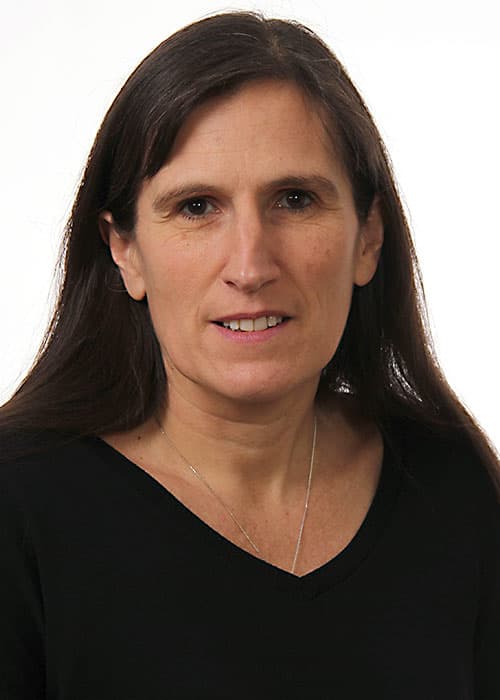
Marie-Noëlle Albert was a manager first. For about ten years she led teams, before turning that experience into an object of research. It is this displacement — from practice towards science, without ever disowning practice — that gives her work its signature.
In 2007 she defended a doctoral thesis in management sciences at Université Jean Moulin Lyon 3, supervised by Marie-José Avenier, on work engagement revisited through the concept of the “self”. She then joined the Université du Québec à Rimouski, where she is a professor in the departmental unit of management sciences.
Her research begins from a simple and demanding conviction: a person is not a resource. The vocabulary of the “human resource” produces the organizations it describes — so it has to change. With Michèle Fortier she proposes a persons management; with Jean-Philippe Pérouma and Nadia Lazzari Dodeler she develops the notion of a community of persons, an organization where dialogue and mutual recognition are not decorative extras but conditions of functioning.
She has also contributed to developing and formalising a research method, autopraxeography, which allows practitioners to build scientific knowledge from their own experience through rigorous reflexive work and dialogue with theory. Several of the theses she has supervised now use this method.
Her most recent work addresses benevolence and solidarity at work, the inclusion of immigrants in the regions — with the organization Accueil et Intégration Bas-Saint-Laurent as its field partner — and what human irrationality holds that artificial intelligence cannot replace.
She is an associate member of the Centre de recherche sur les innovations sociales (CRISES), a member of GRIDEQ and of the ETHOS team at UQAR, and a member of the international network Reliance en Complexité, which grew out of the UNESCO Chair devoted to Edgar Morin’s complexity thinking.
In her own words
« Marie-Noëlle Albert détient un doctorat en sciences de la gestion de l’Université Jean Moulin (Lyon III) et est professeure au département de gestion de l’Université du Québec à Rimouski. Après une expérience de gestionnaire d’une dizaine d’années, elle s’est spécialisée en gestion des personnes en milieu de travail. Elle s’intéresse particulièrement à la manière de légitimer des récits de praticiens, qu’ils soient ou non autobiographiques. »
This is the keystone of her biography, and she wrote it herself. She is not a theorist who came from the university towards practice: she managed for ten years, then made that experience an object of science.
Her whole method follows from that. It also explains the constancy of her question: on what conditions does a practitioner’s account become scientific knowledge?
Stance
Pragmatic constructivism and the complexity paradigm
A direct lineage
Her thesis supervisor, Marie-José Avenier, is a major figure of pragmatic constructivist epistemology in management sciences, herself in dialogue with Jean-Louis Le Moigne. The position is formalised in 2013, with Marie-Michèle Couture, in an article in Recherches qualitatives devoted to the legitimation of knowledge drawn from autobiographical accounts.
Concretely: valid knowledge does not descend from theory towards the field. It is built within experience, then legitimated through rigorous work putting it in dialogue with existing theories.
Edgar Morin, by name
The complexity paradigm is an explicit and avowed pivot, not an ornamental reference. She uses its operators by name — dialogic, recursivity, ingenium — and co-edited an entire thematic issue of the Revue Interventions économiques devoted to that paradigm.
She is also a member of the international network Reliance en Complexité, which grew out of the UNESCO Chair that spreads this way of thinking.
What she works on
Six axes, one single architecture
Persons management
A person is not a resource: what changes when management vocabulary shifts — in theory, and in daily practice.
Community of persons
How an organization moves from an association of individuals to a community, and why genuine dialogue is the condition for it.
Autopraxeography
A method for practitioners to turn lived experience — including difficult experience — into legitimate scientific knowledge.
Complexity thinking
Thinking organizations with Edgar Morin: dialogic, recursivity, and refusing simple answers to complex problems.
Inclusion, diversity and benevolence
What inclusion actually demands of organizations, and why imposed solidarity backfires.
Humans and artificial intelligence
Human irrationality as an asset, not a flaw, in coopetition with artificial intelligence.
Affiliations
The networks that carry this work
- UQAR
Her home institution. She teaches at the graduate level and supervises theses and dissertations in workplace persons management.
- ReCx
A transdisciplinary scholarly network devoted to spreading Edgar Morin’s complexity thinking, born of a meeting between Edgar Morin and Régis Meissonier in March 2019. Marie-Noëlle Albert is listed by name among the network’s members; the network devoted a video portrait to her.
- CRISES
An inter-university centre devoted to social innovation. Declared areas of expertise: human complexity, workplace persons management, human resource management, qualitative research methods.
- GRIDEQ
The group that roots her work in its territory: the inclusion of immigrants is studied at the scale of the Bas-Saint-Laurent, a region far from major centres and without ethnic enclaves.
- ETHOS
UQAR’s ethics team, where the normative side of her work continues: the person as an ethical subject, vulnerability, professional judgement.
- AIBSL
The regional organization welcoming immigrants that serves as the field for her work on benevolence and performance.
Full professor
Member of the network
Associate member
Associate member
Member
Field partner